contributed by Ryan Schaaf & Jack Quinn
Every person loves games.
Albert Einstein himself showed they are the most elevated kind of examination. He knew video games are methods for something deeper and a lot more purposeful than a childlike waste of time. Gamings advertise based learning, or simply put, learning that happens in teams of practice during immersive experiences. Sometimes, playing games are the very first technique youngsters use to explore higher-order thinking abilities associated with developing, evaluating, assessing, and applying new knowledge.
See also 50 Inquiries To Help Students Consider What They Believe
This article is composed in 2 parts. The initial, composed by Ryan Schaaf, Aide Teacher of Innovation at Notre Dame of Maryland College, presents gamification in an instructional context, its many components, and some products that mimic gamified practices. The 2nd part, shared by classroom teacher and trainer Jack Quinn, offers a direct account with viewpoint from a gamified learning expert. Below are our consolidated understandings.
Gamification In An Educational Context
Gamings have numerous aspects that make them effective automobiles for human knowing. They are commonly structured for players to solve a trouble; an essential ability needed for today and tomorrow. Many video games promote communication, collaboration, and also competitors among players. Some of one of the most immersive games have an abundant story that generates creativity and creative imagination in its gamers. Lastly, depending on just how they are developed, video games can both show and check their gamers. They are incredible packages of training, learning, and assessment.
The architectural components of games are also especially matched to serve this existing generation of learners. Generally known as gamification (or gameful design according to Jane McGonigal), this method of adding game aspects such as narration, analytical, visual appeals, rules, collaboration, competition, benefit systems, responses, and finding out via experimentation into non-game situations has already knowledgeable extensive implementation in such areas as advertising and marketing, training, and consumerism with widespread success (see http://www.cio.com/article/ 2900319/ gamification/ 3 -enterprise-gamification-success-stories. html) for more details.
In the education realm, gamification is starting to pick up vapor. With success tales such as Classcraft, Course Dojo, and Rezzly leading the fee, the potential for gamification to infect a growing number of class is a forgone verdict. There are additionally pockets of educators in the teaching landscape that are designing their own ‘gamefully-designed’ discovering environments. The following area checks out such a setting by sharing Jack’s experiences with his very own class.
See likewise 10 Certain Ideas To Gamify Your Class
Gamification: From Theory to Exercise
I have actually been entailed with gamification for quite time now. In my 9 years of experience, I’ve located video games are wonderful at dealing with several typical classroom problems such as: trainee participation/talk time, trainee involvement, differentiation, information monitoring, and raising student success.
As an ancillary language teacher on Jeju Island in South Korea, gamification aided me boost pupil talk time by 300 %. My 250 pupils finished over 27, 000 ‘missions,’ a.k.a. additional research projects they chose to do. My leading 10 % of individuals spent an hour outside of class speaking their target language daily. I was even stunned on more than one celebration to show up early to function and discover my students had defeated me there and were excitedly awaiting my arrival so they could begin their day-to-day missions.
As a classroom teacher in the Houston Independent College district offering institutions with a 95 % cost-free and minimized lunch population, I have shown both 3 rd- grade reading and 5 th- grade scientific research. Each of these is a state-tested topic (that I instructed for 2 years).
Usually in my very first year of instruction, my pupils have done 1 39 times the district standard and 1 82 times the district standard in my second year teaching the topic. Or put another way, typical methods would take 14 to 18 months to attain what I can do with games in 10
I credit a lot of this success to following the advice of Gabe Zicherman from his Google Tech Talk, Enjoyable is the Future: Understanding Gamification , where he encourages game designers to “incentivize whatever you want people to do.” (Zicherman, n.d.)
Because of this I make every effort to identify the crucial actions my trainees require to practice after that construct video games and incentive systems around those activities.
Gamification in education and learning makes use of the auto mechanics of video games– factors, degrees, competitors, challenges, and incentives– to inspire students and make discovering more engaging. Below are 20 functional, classroom-tested instances of gamification that instructors can utilize to enhance inspiration and participation.
1 Providing Points for Fulfilling Academic Objectives
Do students require to mention information from the text and assistance verdicts with evidence? Award 1 factor for a solution without proof, 2 factors for one item of proof, and 3 factors for multiple pieces of evidence. This makes evidence-based assuming quantifiable and motivating.
2 Giving Factors for Procedural or Non-Academic Goals
Intend to shorten the time it requires to examine research? Honor 2 points to every trainee that has their exercise before being motivated. This gamifies procedures and encourages self-management.
3 Creating Spirited Barriers or Obstacles
Present enjoyable barriers — puzzles, puzzles, or time-based challenges– that trainees must get rid of to open the following action of a lesson. These barriers enhance engagement and mirror the challenge-reward loop in games.
4 Producing Healthy And Balanced Competitors in the Classroom
Attempt Teacher vs. Class : Pupils gain factors jointly when they adhere to rules; the instructor earns points when they don’t. If trainees win, award them with a 1 -min dance event, added recess, or minimized research.
5 Comparing and Reviewing Performance
After a task, offer students with a efficiency break down — badges for creativity, synergy, or perseverance, plus stats like “most questions asked” or “highest possible variety of drafts.” Reflection is a core aspect of gamification.
6 Creating a Variety Of One-of-a-kind Incentives
Deal tiered incentives that interest various personalities. For instance: sunglasses for 5 points, shoes-off opportunity for 10, a positive moms and dad message for 15, or the right to “take” the teacher’s chair for the highest possible marker.
7 Using Levels, Checkpoints, and Development
Track factors over numerous days or weeks and let students level up at milestones. Greater degrees open benefits, coach roles, or perk difficulties– mirroring video game development systems.
8 Rating In reverse
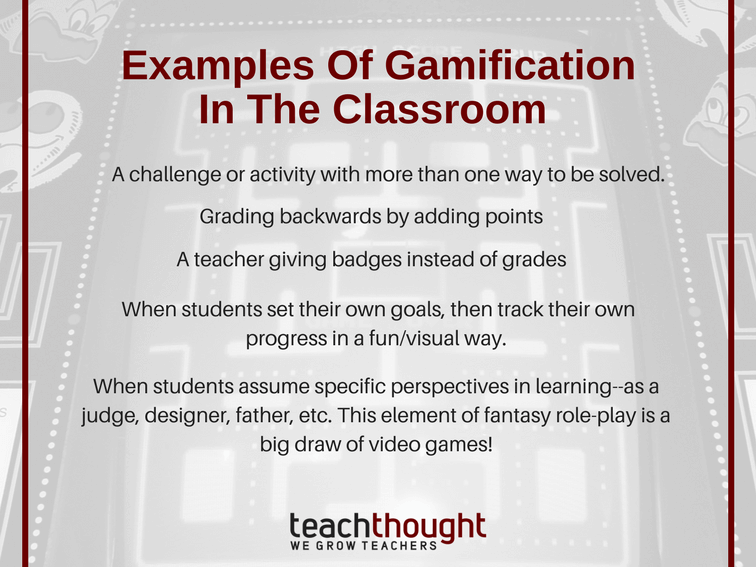
Instead of starting from 100, allow students make factors towards proficiency Each right response, skill demonstration, or positive actions moves them closer to 100 This approach reframes finding out as development as opposed to loss evasion.
9 Producing Multi-Solution Challenges
Design jobs with more than one legitimate service and encourage students to contrast approaches. Reward innovative or distinct services to urge divergent reasoning.
10 Making Use Of Discovering Badges
Rather than (or alongside) qualities, provide electronic or paper badges for accomplishments like “Important Thinker,” “Cooperation Pro,” or “Master of Fractions.” Badges make discovering objectives tangible and collectible.
11 Allowing Trainees Set Their Own Goals
Allow trainees to establish tailored goals, after that track their development aesthetically on a class leaderboard, sticker chart, or digital tracker. Self-directed goal-setting is inspiring and teaches possession.
12 Aiding Students Assume Functions or Personas
Usage role-play to have students act as judges, designers, or chroniclers while working with projects. Role-based discovering take advantage of the immersive nature of games.
13 Class Quests and Storylines
Wrap devices or lessons in a narrative arc (e.g., “Endure the Old People”) where pupils unlock brand-new “phases” by completing projects.
14 Time-Limited Employer Battles
Finish a system with a collective evaluation obstacle where students should “defeat the boss” (respond to a set of difficult troubles) before the timer runs out.
15 Randomized Rewards
Use a mystery incentive system : when trainees earn enough factors, allow them draw from a reward container. The changability keeps motivation high.
16 Digital Leaderboards
Produce a leaderboard for collective factors, badges, or finished difficulties. Public acknowledgment encourages affordable pupils but should be framed positively to prevent reproaching reduced entertainers.
17 Power-Ups for Favorable Behavior
Introduce power-ups such as “added tip,” “skip one homework problem,” or “rest anywhere pass.” Trainees can invest made indicate activate them.
18 Cooperative Course Goals
Set a shared unbiased — if the entire course fulfills a point overall, they make a group incentive like a read-aloud day, a job event, or bonus recess.
19 Daily Streaks
Track daily engagement or homework completion with streak mechanics like those made use of by language-learning applications. Breaking a touch resets progression, encouraging uniformity.
20 Unlockable Bonus Content
Offer bonus offer tasks or secret degrees (problems, video clips, enrichment problems) that students can unlock after meeting a factor limit. This provides innovative trainees extra challenges.
Why Gamification Functions
Gamification transforms routine tasks into interesting challenges, urges innate and extrinsic inspiration, and offers continual feedback. When used attentively, it advertises mastery, partnership, and a sense of progress.
Discover more about gamification in learning , discover game-based discovering approaches , and obtain ideas for increasing student involvement
Perk: Utilizing a scoreboard seats graph
Draw or predict a seating graph onto a whiteboard/screen, and afterwards honor students factors for all activities that you want to incentivize with sustainable rewards/recognitions at different point degrees.
Final thought
Make sure to be innovative and respond to pupil passions. In my course, students do not take practice tests; they fight the evil emperor, Kamico (the maker of preferred test prep workbooks used at my school). We do not just check things for conductivity; we find the secret item which will switch on the alien spaceship’s ‘prepared to release’ light.
While pupils are collecting factors, leveling up, and contending versus each other, I am gathering data, tracking progression, and customizing the guidelines, incentives, and quests to construct positive class society while pushing pupil achievement. Pupils become excited to participate in the activities that they require to do to improve, and when trainees buy-in, they make institution a game worth having fun.
References & & More Checking out
McGonigal, J. (2011 Video gaming can make a far better globe.|TED Talk|TED.com [Video file] Recovered from: ted.com/
Schaaf, R., & & Mohan, N. (2014 Making school a video game worth playing: Digital video games in the classroom SAGE Publications.
Schell, J. (n.d.) When games attack real life.|TED Talk|TED.com [Video file] Gotten from https://www.ted.com/talks/jesse_schell_when_games_invade_real_life
Zicherman. (n.d.). Enjoyable is the Future: Mastering Gamification [Video file] Gotten from youtube.com
12 Instances Of Gamification In The Class